Sunday, March 21, 2010

Berber Television

After nearly a month of stalling, I've finally gotten around to writing my Morocco post. The underlying cause of my lingering procrastination is the daunting task of capturing a country and a culture in a single entry. But, fueled by a fresh batch of Mabel's empanadas and a guilty writer's conscience, I've heartened to try.

We deplaned in Marrakech early on a Friday afternoon and immediately set out to find our hotel. From the city bus windows we watched the countryside turn from pasture to city, motorcycles and cars whizzing by bearing loads no manufacturer could have predicted. One bicyclist carried so many plastic bottles of varying shapes and colors that he must have been using a periscope to see the road. The sky was a blanket of grey, too light to mean rain but too thick for sunlight to get through. Even with the melancholy overhead, Marrakesh glowed in orange and green contrast. Buildings, sidewalk, dirt- all the color of rusted tin cans. Palm trees, orange trees and other fauna filled the space between, punctuating the pumpkin with shades of jade.

While I was busy taking note of the local color scheme, my companions began to note the local language barrier. Moroccans generally speak two languages, as did all of us students. Unfortunately, they spoke French and Arabic and we spoke Spanish and English. Many wrong turns and exasperated hand gestures late, the group arrived at Hotel Mont Gueliz. Before being taken to our rooms, the hotel staff served us our first glasses of sweet mint tea. I don't even like tea and I could drink an entire pot. After dropping our bags, we started our 30 minute walk to the Souk.

Open air market by day, open air restaurant by night, the souk is the largest of its kind in Morocco and among the largest in all of Africa. Smells of horse carriages and incense reach you before the crowds do as you come upon the square. A kaleidoscope of people moves in every direction - snake charmers next to women doing henna tattoos, baboons on chains next to musicians - and everybody wants you to take their picture. Men with snakes so near to death that they hang limply in their hands will throw them about your neck and demand payment for the novelty photo. The baboons are worse because those that aren't on your shoulder looking miserable and plotting retribution toward their masters are probably picking your pockets. Once you make it through the menagerie, the real fun begins.

Alleyway after alleyway of merchants selling everything from carpets to tea kettles to souvenirs winds in a maze of color and perfumed air. Pause for a moment to admire the wallets made of camel hide and you are assaulted by vendors in every language they know. Which happens to be a lot. Depending on your appearance, they may rattle off "good price, good quality, how much you pay?" in german, english, spanish, arabic, french, and italian. The kicker is that upon your response, they can actually converse with you in any of the above as well. These men aren't common street merchants. They're brilliant salesmen who enjoy a good haggle but will assuredly get the better of any foreigner who enters their domain.


When the sun sets, the souk is transformed as the street performers give way to tables and tents. Steam rises from all directions and the bustle and clang of plates and people reverberates through the plaza. People sit cafeteria style sharing picnic tables and choosing varying kebab and cous cous dishes. Bread the size of your head and coca colas accompany the meal before you're hurried along to make room for the next round of hungry guests. After partaking in all of the above and each purchasing a pair of skants - a combination skirt pant that is tight at the ankles and waist and a mass of material everywhere else, the group retired to the hotel in preparation for an early morning.

Skants on, cameras charged, bellies full of bread, jam and tea, the group boarded a van with our guide, Mohael, an ex-Berber nomad. We set out from the city and slowly but
deliberately began to ascend the Atlas Mountains. Our destination, the Zagora Dunes of the Sahara Desert lay on the other side. On our way out of the city, we passed a number of shanty towns with huts and houses made of wood and tarps. On top of many of them, visible through the smoke of cooking fires below, were television satellites. The blue glow of a TV peeked through the cracks of some of the huts in the early morning darkness. Eight or so hours later, after stopping in a museum dedicated to the movie Gladiator in the city where most of the scenes were filmed, we made it to the town where we'd leave our van and opt for hairier transportation.

On the verge where town ends and desert begins, Mohael brought us to our camels. We each picked a beast and began to mount them. My camel was a cream colored dromedary who I affectionately dubbed Herbert. With only a sweatshirt and a toothbrush in a satchel hung from his "saddle", I climbed onto kneeling Herbert. At the command of one of our two Berber nomad escorts, his back-end lurched upwards and I nearly ate a mouthful of coarse white camel hair. His front followed next and fully righted, we stood nearly ten feet tall. Herbert turned his lanky neck and regarded me dubiously with one big dark eye. I tried to look as un-annoying as possible while recalling stories of camels spitting and biting off the fingers of their caretakers. Herbert, apparently content with his charge, blinked his massive eyelashes and swung his gigantic head back around.

Nine camels strung together in two lines began to traipse across the sand dunes. Intoxicated by our incredible situation, we sang Aladin's "Arabian Nights" from the backs of our camels as we followed our Berber guides into the desert. Soon after we began our trek, the sun began to set. The lights of the village obscured by distance and sand dunes, we had the light of a 3/4 moon to see by. Even with the white glow, it became harder and harder to see more than a camel or two ahead and we wondered how our guides had any idea where they were going. After an hour and a half undulating on Herbert's back, I recalled another tale I'd heard about camels: they're incredibly uncomfortable to ride for long distances. I can now attest to that. In fact, I'm not altogether sure how men ride them at all. After an hour and a half I was more than ready to cry uncle. Lucky for me and due to the uncanny expertise of our Berbers, we finally saw light in the distance.

We left our camels outside a ring of tents and followed our Berbers into the biggest one. As the flap opened to admit us, we were bathed in light and the smell of cooking food. Seated on cushions around a circular table with other tourists, we were served mint tea again. "Berber whiskey", one of our guides called it. Next came a steaming tajin, or bowl of chicken, potatoes and vegetables for the table to share. After we had eaten, a few 20-something Berber men came into the tent with drums and hand cymbals. Eventually, the entire tent was dancing to the thumping and clashing of the instruments.

Once the music had ended and most of the travelers had retired to their tents for the night, only our group and a handful of young Berbers remained. Seated next to our guide on a cushion, I ventured a question. "Where are the women?" I asked. Uneasy with my question, "not here" was my curt reply. Mental note taken: don't talk girls with patriarchal nomads. The mood stayed light, though and soon they asked if we would like to join them to watch shooting stars on the dunes. The men laid carpets out on top of a dune and sat boy-girl with us in a very 15-years-olds at a movie theater sort of way. They asked our boys if they were sure that they weren't tired. "Don't you want to go back to the tent?" they'd joke in an innocent way. Sand whipping about in the night wind, they helped us fashion head scarves and veils from our neck scarves. As we watched stars shoot across a speckled sky, one Berber pointed his finger. "Berber television" he said with a smile.

That night we slept five and four on bedrolls in our tents with only one candle and camera glow to last us until morning. Hearing wild dogs barking in the distance, I woke as the sky was turning a dawn grey. I sought out Herbert and pet his massive head as I watched the hues of orange and pink come and go in the morning sky. The Berbers eventually woke the camp and called us into the big tent for a slice of bread and a cup of tea before sending us back to the village. Soreness compounded from the night before but sad to part ways, saying goodbye to Herbert and our guides was bittersweet. We took the same journey back over the mountain, passing again from desert to foothill to snow covered peaks and back down the other side and into Marrakech. Skants smelling of camel, we were glad to return to our hotel for a shower and a bed, ready to head back to España the next morning.

All in all, I fell in love with Morocco and the Berbers, Marrakech and the people. But, were I a man, I would love it even more. The male dominated society has little effect on women tourists as long as your respectful, but the Berber man's brusque answer in the tent reminded me that women in Morocco don't walk about freely like I do. Even as a tourist, I noticed that although I was the best haggler out of our group of girls, I received only a portion of the recognition and deference that my male companions were shown in the souk. The food, the music, the life in general is beautiful and I can't wait to return someday, but it's unfortunate that I could never live there and feel the same way.

Thursday, February 18, 2010

We lost Betty Crocker at the Alamo?

Decision: put the American girl with no rhythm, who's a terrible swimmer, doesn't know the word for rowboat, paddle, or SOS for that matter, as captain for a tiny tipsy vessel in the Mediterranean - in hindsight, not a good idea. Water Sports Class was going swimmingly (forgive the pun) until a recent fateful afternoon.
The miniature cousin of oxford crew boats, our crafts are manned by four rowers and a captain who steers and acts as human-metronome for the oars to follow. Split into a group with two Romanian girls and a Spanish boy and girl, I received the honor of acting as captain and translator for the group. The Romanians spoke English and little Spanish and the Spaniards spoke only their native tongue. With little direction other than how to attach the oars, our instructors shoved us off from the deck and into the harbor.
It only took 60 seconds for us to crash into another dock. Once we reached more open water, we nearly capsized on multiple occasions because 1- The Romanians didn't understand that rowing is a circular motion and instead chose to wiggle their oars up and down, 2- The wind pushed us dangerously close to other (much larger) boats anchored in the marina, 3- I can't give directions and keep a beat out-loud at the same time to save my life. An hour and a half of frantic Spanglish and frenzied rowing later, we returned to the dock with a sense of pride that we hadn't fallen into the ocean or destroyed the equipment. Our instructors inconceivably believe that we're ready to move onto personal one-man watercraft next. God help us all.
When not cheating death on the open seas, Medieval and Mexican Literature exhaust the rest of my brainpower. In Medieval, we're reading the equivalent of Old English - spelling is more art than science, giving authors plenty of room to wax creative in their choice of letters. Needless to say, it's a bit of a challenge. Mexican Lit is much easier but equally engaging. Taught by one of our program directors, the class meets in the headquarters of a club for Northern Spaniards in Alicante. With couches, tables and chairs, the "classroom" provides an intimate and open setting for our discussions of Mexican American culture and the texts associated with it.
Learning the history of the western United States from a third-party Spanish view is fascinating. We're constantly feeling sheepish for the lack of memory we have of 5th and 8th grade American History. Mr. Shores would be ashamed that I couldn't remember the name of the Treaty of Guadalupe Hidalgo. I feel less moronic than some of my companions however, e.g. the quote that I chose for the title of this post. Yes, an American actually asked, "Wait, we lost Betty Crocker at the Alamo?" Indeed, and that explains the sad reality that she hasn't written any more cookbooks.

Friday, February 12, 2010

Bar(th)elona

Barce! Barce! Baaaaaarce! The voices of 110,000 Spaniards chant this in unison at every FC Barcelona home game. The air in Camp Nou vibrates with an energy akin to that in an NFL stadium on Superbowl Sunday. Every call the referee makes is a matter of life and death, and at times you feel like a spectator in the Colosseum, deciding the fate of the warriors below with the opinion of the crowd and the strength of your lungs. When Barcelona wins, which of course they do, the fans beam like proud parents. You half expect them to point out a player and say, "see number 10? Messi? That's my boy." We wear the Barce scarves we purchased only hours before as if we've always had them, as if we belong to this clan of victorious soccer hooligans. Riding the subway back to the hostel, still basking in the glow of European futbol glory, we're quiet and content like children in the back seat on the way home from the circus. We anticipate describing the event to our friends and family, but realize that nothing we can say can capture the magic of that stadium on that particular February evening.


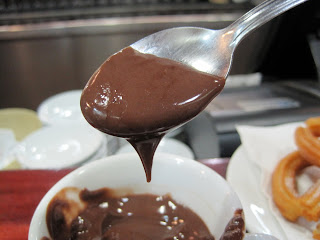
While less momentous than the soccer game, the rest of our Barcelona weekend was one of my best yet in Spain. Our hostel was a bohemian hideaway a ways from the city center, complete with Tibetan prayer flags, hammocks, and a guitar for guests to strum. The ten of us slept on bunk beds in a 12-person room with a communal bathroom down the hall. We began our Barce exploration by hitting some of the major tourist stops, eg their Arc de Triunfo and the castle Montjuic, and rounded out our day by stopping for chocolate con churros- molasses-thick hot chocolate with fried funnel cake-esque dough for dipping. When the churros are gone, the Spaniards actually drink the cocao concoction. We opted for spoons and scooping instead.


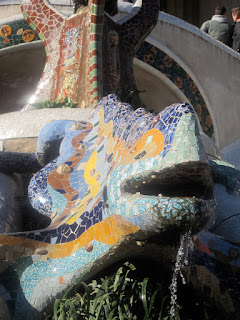
Our first night in Barcelona was both serendipitous and hilarious, involving everything from accidental entrances to gay clubs to 5 a.m. to exuberant street performers. At one fateful moment, a friend from back in the states even happened to emerge from the taxi we were trying to hire. The next morning, the troops rallied splendidly and we set out for more wanderings. Starting with the Sagrada Familia, Gaudi's yet unfinished cathedral, we made a day of all things Gaudi. From the Sagrada we walked to Park Guell, the hillside menagerie for many of Gaudi's fanciful creations. A "gingerbread house" sits across from a giant rainbow mosaic lizard, spewing water from the intricate fountain upon which it perches. Spires of strange shapes and colors punctuate the horizon and you feel as if you've wandered out of the city and into a fairytale. Our time in Park Guell was limited by the soccer game that evening, but we had time to get lost (both literally and figuratively) in the tangle of nature and Gaudi.


We spent our last day in Barcelona visiting museums. The Picasso held works from his childhood and early schooling. My favorite was his first entry to a major show, a photo-quality and nearly life-size image of a child's First Communion. While overall slightly underwhelming, I'm still glad we went to the museum. The collection served as a reminder that Picasso meant to make every brush stroke on his strange works from later periods. If he wanted them to look realistic, he would have done so. Sometimes I think, "well I could have painted that silly thing," but now I realize that old Pablo really did paint with purpose. Another academic highlight from our last day was the History Museum, a tiny building hidden on a narrow side street. The modern architecture actually sits upon ancient Roman ruins that you can descend a staircase to explore. Lit like the Bat Cave, cold and eerie, you could walk through them on a winding platform. If you looked closely, you could catch writings etched in the walls, sometimes in latin, sometimes in Hebrew. I had a little tinge of cultural pride when I recognized this and was able to point it out to a fellow traveler. Our time again hampered, we were soon forced to leave the city center for the train station to head back to Alicante.

Wednesday, February 3, 2010

The One Month Mark

This Friday marks the one month point of my Spanish excursion. I was planning on blogging a reflection of my stay so far on the day itself, but my itch to travel has caused me to be in Barcelona at that time, sans laptop.
The 30 days I've spent here have flow by so quickly that I feel like I've just arrived. At the same time, I notice myself speaking a form of Spanglish to my English compatriots and forgetting how to conjugate words in English. I must be talking and acting more like a Spaniard because this week, to my utter surprise, a Spanish student asked me where the post office was. Not only did I get the perk to my pride that she asked me, but I could actually answer too. I didn't fare nearly as well when a woman asked me for the Economics Building, but I'm still chalking that one up as another point for not looking like an American.
The above is a picture of the Castle Santa Barbara, to which I run on a daily basis. That is, when gale force winds don't force me to opt for the beach instead. The photo that follow is a friend from Alabama on top of said castle. Don't worry Grandma, I would never dream of doing this myself. I was happy to serve as action photographer though.
Mid-post, I just decide that my blogs tend to grow a bit lengthy since I wait until I have plenty of material before posting. No guarantee, but I'm going to make an effort to post more often and more concisely. I'll absolutely have another lengthy novel to write after Barcelona this weekend, however. An FC Barcelona fútbol game, the Picasson Museum, The Sacred Family Cathedral etc. will be sure to prompt a sizable entry.

Tuesday, January 26, 2010

Settled In

It's funny how a six minute shower makes you reminisce fondly upon the days when your step father would bang on the bathroom door and exclaim, "Is that Niagra Falls in there!" in his fatherliest of voices because you spent so long basking in the hot water and steam that you fogged the mirror and your fingers pruned. It's not that I've had a change of showering preferences. It has just become difficult to wax languorous when the stream turns to ice approximately five and a half minutes in. Besides my aversion to our small water heater, I find myself settling in nicely to my new Spanish life.
This afternoon after class, I climbed the three flights of stairs to Mabel's apartment and eased the door open. No one in sight, I tiptoed to my room as quietly as my clunky boots would allow as to not wake Mabel, the hellion that is our sleeping lab puppy, or anyone else who may be dozing. I spent the afternoon planning a trip to Barcelona with my American companions and perfecting my procrastination skills. Eventually, guilt drew me out of my room and onto the couch next to Paula.
While Paula studied the 15 verbs her English teacher had assigned her, I used her as a human dictionary for the words I didn't know in my own homework.
"Brogaht," she'd say. Without raising my eyes from my lap, "brought," I'd correct. She'd roll her eyes in an "English is a stupid language with extra letters" kind of way. A moment later, I'd ask "mancharme?" and she'd mime spilling something on her shirt.
When 8 o'clock rolled around, it was time to take the deranged puppy to the dog park. I use this term lightly, as the dog park here is simply a plaza with a low fence where Spaniard canines and their human companions come to socialize. Yorkies sniffed the tails of Pomeranian while French Bulldogs tumbled with terriers, all sans leash. Our Lola, practically their size at three months, remained leash-bound, more for the safety of the smaller dogs than for her own. She leaped playfully at a French Bulldog and caught one of its jowls in her sharp puppy teeth. Part snapping turtle, Lola releases only when she wants to - the reason my sweatpants are torn and the frenchy had her doggy butt kicked by a puppy.
When Lola was good and tired, we headed home for ham and cheese ravioli. Starving by 9 o'clock, I cleaned my plate and mopped the sauce with the french bread we have at every meal. Now I'm sitting contently on the sofa with Paula, writing this instead of finishing my homework. A Nickelodeon show featuring teenagers in all forms of undress and partaking in all sorts of illegal activities plays in the background and Paula is captivated. I don't think the FCC would let the Nick back home get away with this, but vidiot Paula is unfazed.
All in all, I'm getting very settled in at my new home. Paula already saves me a seat next to her at the dinner table, Lola bites me less than the mopey French girl, and Mabel seems genuinely happy to see me in the morning. I'm waiting patiently for the wave of homesickness and Spanish vexation to bring me down, but until then I'm as content as a shrimp on a paella.

Tuesday, January 19, 2010

Granada Part 1


Do you like fried eggs? Do you like hamburgers? How about fried eggs on your hamburgers? Well thanks to Mabel, I thoroughly enjoy the combination. After a hearty dinner followed by strawberries for dessert, I finally have the gusto to sit down and attempt to fit Granada into a single blog post. Squeezing an ancient Moorish castle, cathedral, discotec and barrio into a paragraph of prose is no easy feat.
After class with Diego and the pocket twins (what we've come to call the Japanese girls since they're almost identical and are dwarfed by large toddlers), a group of 50 Americans boarded a bus to Granada. At our four star hotel, we split into groups of three or four and were assigned rooms together on the first floor. Management would eventually learn that putting that many gringos together in a combined space is equivalent to housing as many monkeys.
Our bags unloaded and our stomachs growling, we had a quick dinner at the hotel buffet and boarded mini buses headed toward the caves. Barreling down "two-way" roads with room for only one-way traffic, I developed a sudden fear of car travel. Apparently in the right hands, a mini bus can corner and handle like any BMW, but I still attest that there should be about four scraped walls, eight side-swiped vehicles, and three people in the hospital after our jaunt up through the city.
Upon reaching our destination, heart racing but car intact, we entered one of three white-washed Flamenco "caves". The rock crevices had been smoothed and shaped on the inside, becoming short tunnels bathed in shades of red, green and blue emanating from strings of lights hung from the walls and ceiling. The walls lined with chairs left little room for the dance floor. A hush fell over the chatty group of Americans as the performers entered. The guitarist began to pick at his strings, and a deep, murky voice began to sing slow Spanish that reverberated off the cave floor and walls. A dark señorita came forward, her face stony, black eyebrows creased. She started to dance slowly, the pounding of her heel punctuating the somber song of the cantor behind her. As the tempo increased, she was joined by a man who matched the passion in her face and feet with masculine moves of his own. The setting was so intimate that the students closest to the stage could see and feel the flying sweat of the dancers as they twirled and stomped. Eventually, the first pair was replaced by another dancer, then another and another. An hour and a half later, our bodies began to defy our captivated minds and a Gringo or two's head lolled on their shoulders. There would be no fiesta en la calle in Granada tonight.
The next morning, we met Cynthia and Armando in the lobby for a trip to a certain cathedral of scant importance. Armando waited until we had all walked there and gathered outside its vast doorway, bell clanging rhythmically overhead, to tell us of its significance. On this very spot, he told us, Queen Isabella and King Ferdinand signed the contract allowing Christopher Columbus to search for a new route to India, consequently changing the fate of civilization forever. As we stood in awe, contemplating the magnitude of the event, we realized the meaning of the ringing overhead. The peals marked the death of an Español and we were standing in the path of a funeral march. A hearse rounded the cobblestone corner followed by a procession of mourners. The contrition we felt was immediate, and we felt the need to run from their path. Reverence for the deceased had us walking slowly away, sheepish that we silly tourists had been snapping photos while there were actual lives being led.
After a quiet walk back to the hotel, we had an afternoon free for shopping and preparation for the night to come. The Moorish influence was palpable in the souvenir district, hookahs on every corner, rugs for sale and incense filling the shops with smoke and smell. Shopping successful, we set out to find what the streets of Granada had to offer nighttime wanderers. Successful at this endeavor as well, we stopped at a kebab shop in the wee hours of the morning on our way home. Whether due to our current states or the expertise of the vendor, they were by far the best kebabs we had ever tasted.

Wednesday, January 13, 2010

Dormir, clase, dormir, comer, salir, repeat

It's the evening after day three of Spanish class with Professor Diego y los Japoneses. Every day, we gringos take the bus to the University for our three hour intensive Spanish class. Ours is composed of five other Americans and four Japanese students. Yuko and Kaori,the pocket twins as we've come to call them, are two pint-sized prodigy who whisper Spanish without any trouble pronouncing their "r"s and "l"s. Talking to the Japanese students, we find it strange to only be able to communicate in a language foreign to both our cultures, wanting to substitute an english word when you get stuck but met with only wrinkled brows. The class tends to drag toward the end of the third hour but our mid-day break for bocadillos (sandwiches) and juiceboxes that our mothers pack for us provide both kindergarten nostalgia and a welcome recess. When the school day ends, we take bus 24 home and either explore our neighborhoods or curl up for siestas. Our choice of activity depends heavily on whether we were out at Carpe Diem and Mulligan's until 4 in the morning the night before. According to my host mother, Mabel, this is simply a good start to my evening explorations. Until I surpass the 8 a.m. mark she's unlikely to be impressed. Apparently this Americana needs to acclimate herself with the Alicante sleep schedule since, three hour siesta included, I'm more than ready for a good night's sleep. Hasta luego.